
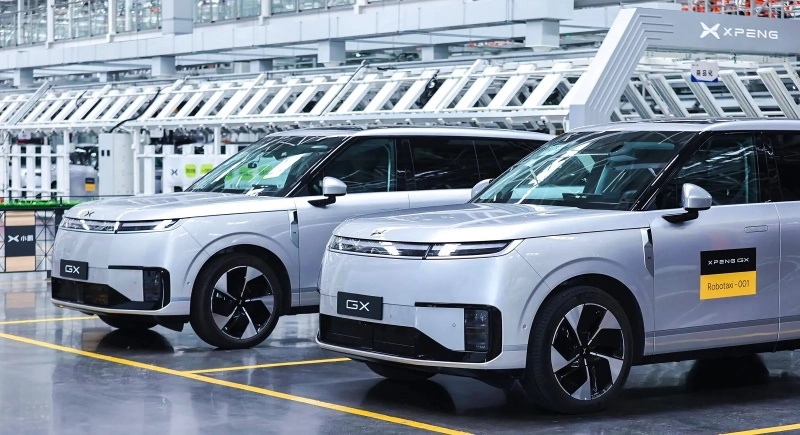
In a strategic move aimed at reshaping the future of urban mobility, Chinese electric vehicle giant Xpeng has officially announced the launch of mass production of its first robo-taxi at its headquarters in Guangzhou. With a highly ambitious timeline, the company is accelerating the transition to autonomous vehicles and humanoid robotics, promising fully autonomous, driverless safety services by early 2027.
The new vehicle, built on the GX modular platform, marks a turning point in the industry: it is the first “pre-assembled and ready for mass production” robotaxi developed entirely with its own technologies (full-stack) in China. Xpeng not only assembles the car, but also controls the entire ecosystem – from artificial intelligence software to processing chips.
To accelerate this journey, Xpeng has set up a dedicated Robotaxi division, making it a top priority for the company. Xpeng President Brian Gu confirmed that in the next 12-18 months, the production rate will reach a cadence of several hundred to several thousand units, paving the way for an expanded fleet.
Unlike many global competitors that rely on expensive LiDAR sensors and high-definition digital maps (HD maps), Xpeng relies on an approach similar to that of Tesla: "pure vision" (a solution based exclusively on video cameras).
Beyond the driving technology, Xpeng promises a premium passenger experience. The interior is set up like a luxury lounge, complete with privacy windows, zero-gravity seats, rear-seat entertainment screens, and an intelligent voice assistant that lets passengers control all vehicle settings.
Xpeng’s strategy is not just about technological innovation, but also about financial sustainability. By eliminating expensive sensors and integrating production into existing assembly lines, the company aims to keep the production cost of a robotaxi below CNY 200,000 (about $29,100). This competitive price gives it a major advantage over Western and local rivals.
"The robotaxi sector is at a critical inflection point, transitioning from technical validation to large-scale commercialization," company representatives said.
To ensure rapid adoption, Xpeng will open-source the robotaxi software development kit (SDK), having already announced navigation service Amap as the first global partner in the ecosystem.
In the world's largest and most competitive auto market, Xpeng is taking a bold step forward. The launch of this production robotaxi is both a show of technological strength and a smart defensive move in the context of a fierce price war in the conventional electric vehicle segment.
It remains to be seen how quickly regulators will react to approvals for driverless public transportation, but one thing is certain: the autonomous future is no longer a distant promise, but a reality that has just entered the assembly line.