
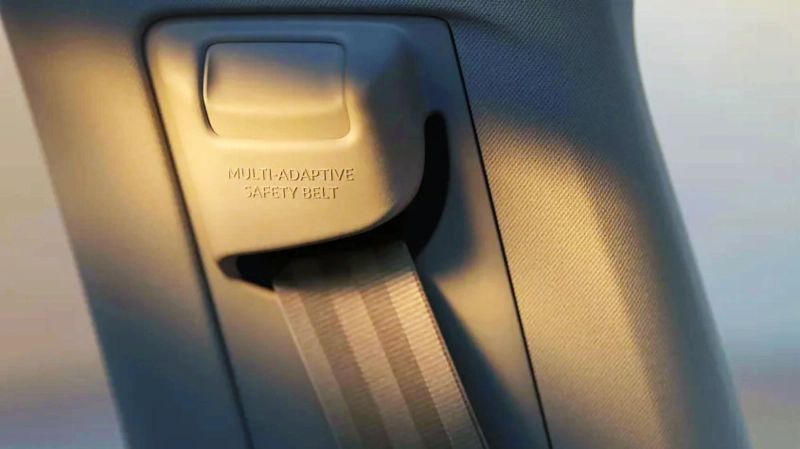
In 1959, Volvo changed the course of automotive history by introducing the three-point seat belt, an invention that the Swedes chose not to patent, offering it free to all manufacturers to save lives. Today, in 2026, the Gothenburg manufacturer is rewriting the rules of the game again: the seat belt is no longer just a textile strap, but an intelligent system that "feels" who you are.
Here's how Volvo's new multi-adaptive seatbelt promises to eliminate the collateral risks of impact, officially debuting on the long-awaited Volvo EX60 model.
Although the seat belt is the most effective life-saving device in history, it was designed for decades for the “average passenger.” For people with a fragile constitution, children or the elderly, the restraining force of a classic belt during an accident can sometimes cause chest injuries.
Volvo's new technology eliminates this trade-off by using an ecosystem of pressure sensors and high-resolution video cameras located in the cabin.
How the system works:
"Safety shouldn't be a statistical average. With the new multi-adaptive seatbelt, we're transforming passive protection into active and personalized protection," the Swedish engineers seem to be conveying through this launch.
While the system is based on 11 occupant categories at launch, Volvo has already confirmed that this is just the foundation. Through an Over-the-Air (OTA) software update, the algorithm will evolve towards a continuous calculation model.
It’s no coincidence that this technology debuts in the Volvo EX60. As the electric successor to the popular XC60, this model is the flagship of safety technology for the masses. In addition to the revolutionary seatbelt, the EX60 integrates this system with adaptive airbags, creating a “survival cell” that communicates in real time.
| Feature | Classic Seatbelt | Volvo Multi-Adaptive Belt |
| Force Adjustment | Fixed/Mechanical | Dynamic/Electronic |
| Sensors | Inertial | Video Cameras + Weight Sensors |
| Personalization | None | 11 profiles -> Infinite (via Software) |
| Primary Objective | Passenger restraint | Minimizing internal injuries |
Volvo proves once again that true innovation is not just about bigger screens or extended range, but about details that make the difference between life and death. The multi-adaptive seatbelt transforms a commonplace object into an intelligent road companion.
Should we expect this technology to become the new industry standard? History tells us that when Volvo launches something safety-related, the rest of the world watches closely (and usually copies).