
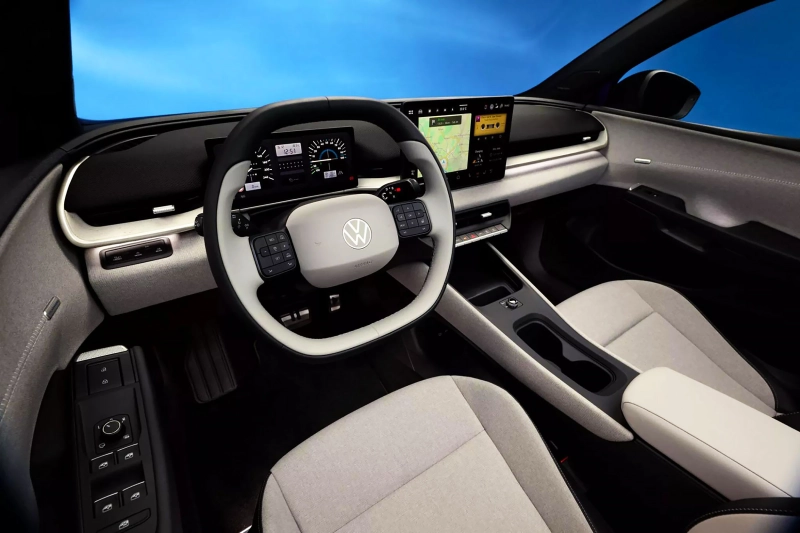
Volkswagen has taken a bold step into the future, but with a nostalgic look in the rearview mirror. The first official images of the interior of the new ID. Polo (derived from the ID. 2all concept) reveal a radical change of strategy: physical buttons are back. This decision marks the end of the era of tactile sliders criticized by fans and promises a much more intuitive driving experience.
Under the baton of the new head of design, Andreas Mindt, the ID. Polo becomes the ambassador of the brand's new visual language. The most important message conveyed by the manufacturer is that the interiors of future VW models will once again be "friendly".
Physical controls: Below the generous 13-inch screen, we now find a bar with illuminated physical buttons for climate control. Goodbye, sliding temperature adjustment in the dark!
Rotary selector: A metallic rotary selector appears on the center console, a design piece that allows volume control and menu navigation, providing that tactile feedback that was missing from current ID models.
Classic steering wheel: The steering wheel forgoes tactile surfaces in favor of buttons with real "click", preventing accidental activations during maneuvers.
Digital nostalgia: The software allows you to transform the 10.25-inch digital dashboard into a retro interface. You can choose between the "Beetle Era" or "Golf Era" modes, with graphics that perfectly mimic the analog clocks of the 70s and 80s.
Although built on the new MEB+ platform, the ID. Polo retains the compact spirit that made it famous. With a length of approximately 4,053 mm, it still offers interior space comparable to a Golf, thanks to its 2,600 mm wheelbase.
Customers will be able to choose between two battery options: an affordable 37 kWh LFP variant and a 52 kWh NMC, capable of a range of up to 450 km. For those looking for adrenaline, the GTI version will deliver 223 hp, promising a 0-100 km/h sprint in less than 7 seconds.
In Romania, the Volkswagen Polo has always been a pillar of the B-segment. From police car fleets to the first car of young drivers, the Polo has dominated through resale value and reliability. Currently, the thermal model remains popular on the second-hand market, but also in operational leasing offers for companies.
How much will the new ID. Polo cost? Volkswagen has officially confirmed a starting price of under 25,000 euros in Germany. For the Romanian market, this is essential:
With the Rabla Plus Program: If government subsidies remain at attractive levels, the final price could drop below the 20,000 euro threshold, making it a direct competitor not only to other electric cars, but also to well-equipped gasoline models.
Launch: The production model is expected to arrive in showrooms in Romania in the first part of 2026.
"The ID. Polo is not just a new car; it is our promise that we have listened to our customers. Stability, friendliness and emotion — these are the values we are bringing back into the cabin," said Andreas Mindt.
The new Volkswagen ID. Polo is more than just an affordable electric model; it is the German giant's official "mea culpa" to its customers. The recognition that touchscreens and glossy surfaces cannot replace the precision of a physical button shows that Volkswagen is ready to become the "people's car" again in the digital age.
If the price of 25,000 euros is maintained, and the quality of the interior materials honors the brand's heritage, the ID. Polo has every chance of becoming the new benchmark for European cities. It is a car that manages to reconcile tomorrow's technology with yesterday's ergonomics, offering exactly what drivers have been asking for: simplicity, control and a touch of nostalgia.