
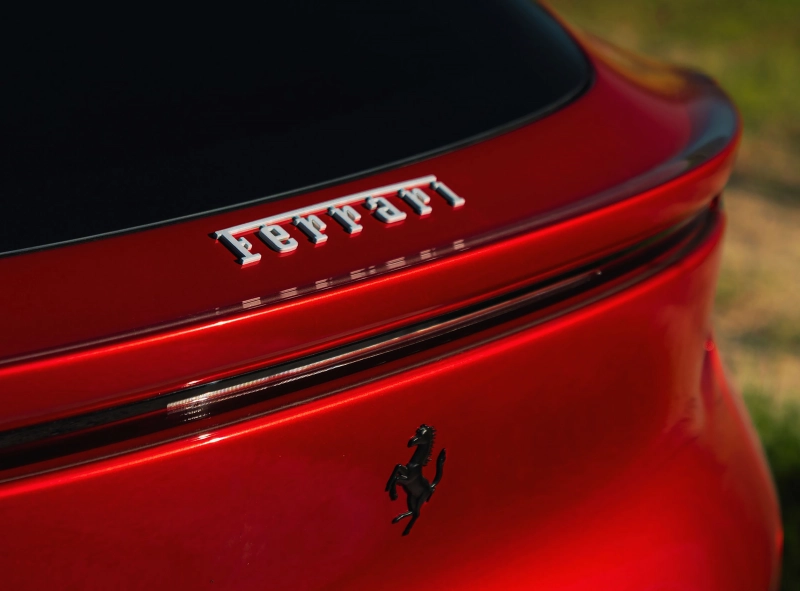
In an era where the auto industry seems mesmerized by giant screens, complex algorithms and the promise of self-driving vehicles, the Maranello-based manufacturer is drawing an unwavering red line. Ferrari, the ultimate symbol of speed and passion on four wheels, refuses to hand over control to artificial intelligence.
After opening a bold new chapter in its history with the launch of its first fully electric model, Luce, fans of the brand began to wonder: is total robotization coming? The answer provided by the company's CEO, Benedetto Vigna, is a categorical "no", spoken with the firmness typical of a brand built on pure emotion.
In a statement that will surely go down in automotive management history, Benedetto Vigna has dispelled any speculation about a prancing horse robotaxi. For Ferrari, technology must serve the human experience, not replace it.
“We’re not going to make fully autonomous cars, period. We want people to have fun, not chips. We want to have a steering wheel and a man or woman behind the wheel. Otherwise, why would you buy a Ferrari?”
— Benedetto Vigna, Ferrari CEO
This bold positioning reminds the world why the Italian brand holds a special place in the hearts of purists. A Ferrari is not simply a means of transportation from point A to point B; it is an extension of the desire for control, adrenaline, and the mechanical connection between man and machine.
But rejecting autonomy doesn't mean Ferrari is stuck in the past. On the contrary, the brand is in the midst of the biggest technological transformation in its history:
However, whether there is a V12 engine or a state-of-the-art battery pack under the hood, the central element remains unchanged: the driver.
Not producing autonomous cars does not mean rejecting innovation. Future Ferrari models will be equipped with increasingly sophisticated advanced driver assistance systems (ADAS). The difference lies in the philosophy behind these systems.
While other companies are developing technologies so that the driver can read a book or sleep during the journey, Ferrari will use technology to make the driver a better pilot. Electronic systems will act as an invisible co-pilot, able to increase safety and optimize trajectories on the circuit, but the final control will always belong to the human.
In a world that is moving towards uniformity and automation, Ferrari chooses to remain a bastion of human control. After all, the value of a Ferrari lies not in its ability to navigate city traffic on its own, but in the thrill you feel when your hands grip the steering wheel and your foot presses the accelerator.