Audi Launches Completely New User Interface for 2026 Models
German premium carmaker Audi is preparing to redefine the in-car experience, announcing a suite of major hardware and software updates for the user interface (UI) of its 2026 models. These innovations are intended for vehicles based on the latest-generation PPE (Premium Platform Electric) and PPC (Premium Platform Combustion) platforms, signaling a commitment to offering cutting-edge technology regardless of engine type.
The updates will be introduced on key models, such as the new generations of the A5 and Q5 with thermal engines, but also on the electric variants A6 e-tron and Q6 e-tron, which will be available for order starting in December of this year.
A New Era of Interaction
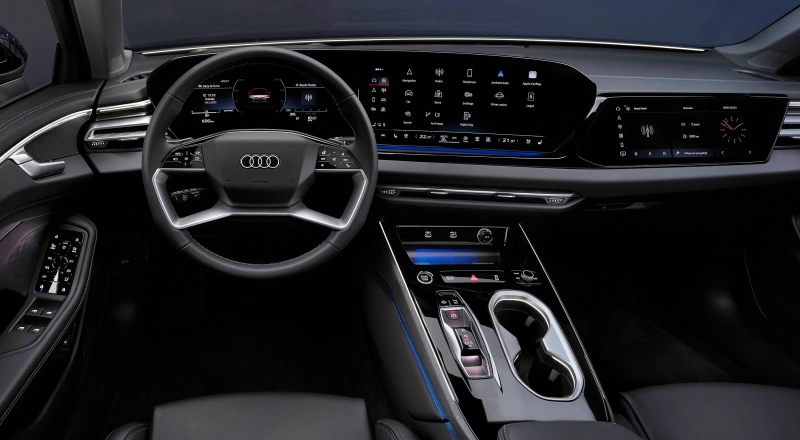
The most visible transformation occurs at the screen level, where drivers will encounter a completely redesigned menu structure and graphics.
- The return of the “Big Map”: Great news for brand fans is the return of the full-screen map display functionality of the instrument cluster in front of the driver (Audi Virtual Cockpit). This feature, appreciated for its visibility, returns to improve navigation.
- Clearer and more customizable displays: Audi will introduce new background colors, moving away from the current monochrome interfaces, which were sometimes difficult to read. This not only modernizes the look, but also improves readability.
- Advanced Smartphone Integration: Phone connectivity systems such as Apple CarPlay and Android Auto are getting improved integration. Their content will be projected onto the driver’s display and, for the first time, onto the optional front passenger display, transforming the cabin into a connected entertainment and information space. The MMI screens could include a 14.5-inch central display and a 10.9-inch passenger display, offering an enhanced user experience and even the option of in-car gaming.
Hardware and Artificial Intelligence
The changes don't stop at software, also touching essential control elements:
- Physical Controls on the Steering Wheel: Audi is responding to customer feedback by reintroducing physical controls on the new multifunction steering wheel. This move contrasts with the general trend of using all-touch controls, emphasizing safety and ease of use, allowing the driver to operate essential functions without taking their eyes off the road.
- AI-powered Voice Assistant: The voice assistant has been upgraded with artificial intelligence (AI)-powered software (including ChatGPT knowledge integration), promising more natural responses, expanded functionality and a more intuitive interaction with the vehicle.
Driving Dynamics and Efficiency
Electric and performance models benefit from specific improvements:
- Improved Regenerative Braking on e-tron Models: Electric vehicles, such as the A6 and Q6 e-tron, are receiving a software update that recalibrates the regenerative braking system. This improves efficiency and, most notably, allows the cars to come to a complete stop using regenerative braking alone, contributing to a smoother and more comfortable driving experience.
- Dynamic Plus mode for S models: The high-performance variants, the S5 and S6 e-tron, will feature a new driving mode called Dynamic Plus. It fine-tunes the calibrations of the Quattro all-wheel drive system and the optional Quattro Sport differential for a more intense and emotional driving experience. In addition, activating Dynamic Plus on the S5 will display a unique central tachometer in the driver display.
Availability and Restrictions
It is important to note that these comprehensive updates, which combine hardware and software changes, cannot be retroactively installed on existing models. Also, the A6 sedan and Avant versions with combustion engines will not benefit from these innovations for the time being.
With these updates for the 2026 model year, Audi is demonstrating that its PPE and PPC platforms are designed to be viable in the long term, consistently offering cutting-edge functions and experiences, whether we are talking about advanced driver assistance systems or new ways of digital interaction.