
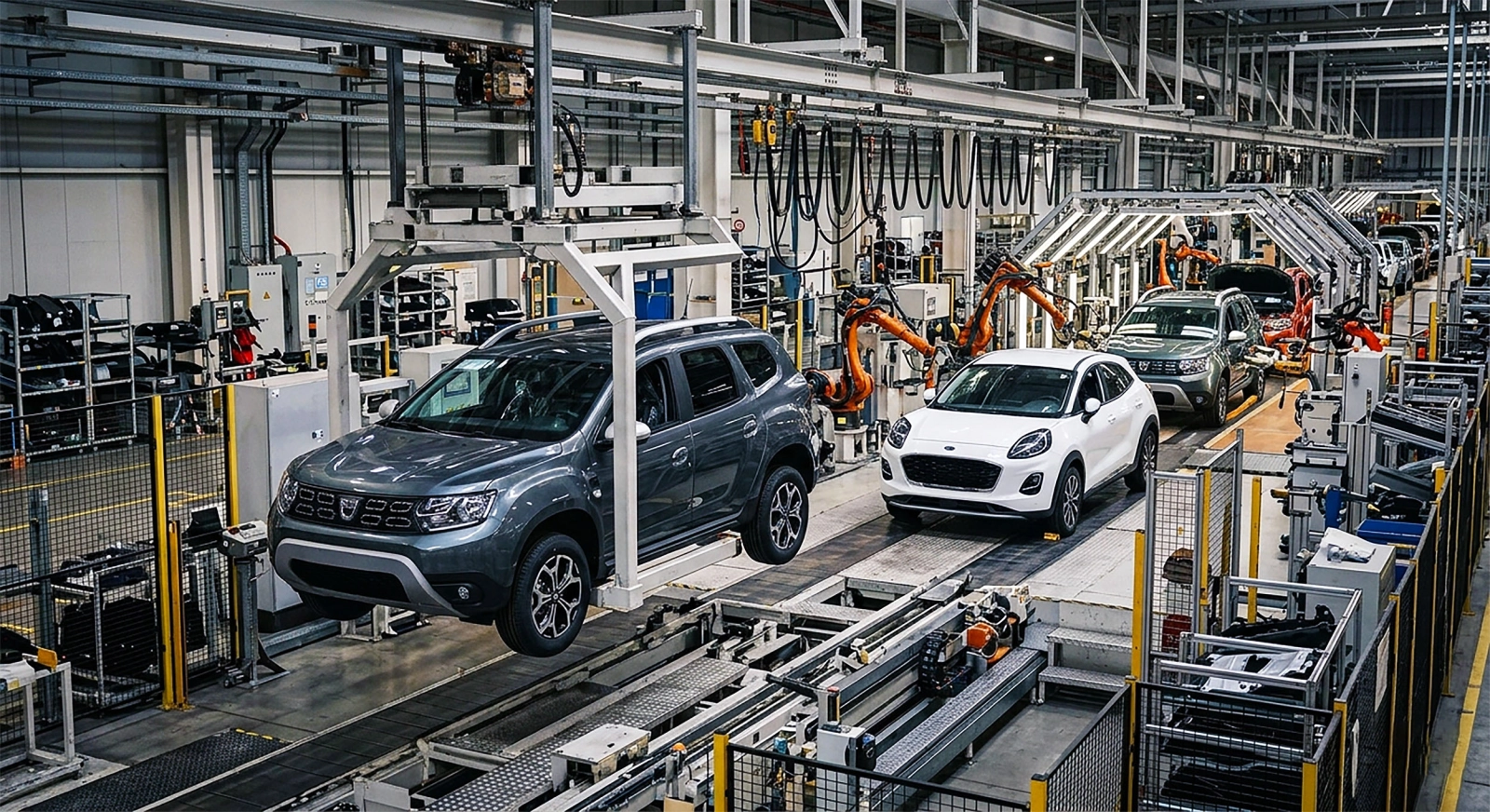
The Romanian car manufacturing industry, one of the main pillars of the national economy and an essential engine for exports, is going through a difficult time. According to the latest data published by the Romanian Automobile Manufacturers Association (ACAROM), car production registered a sharp decline in May, confirming a worrying trend visible since the beginning of this year.
In May, 43,677 cars rolled off the factory doors in Romania. At first glance, the number seems impressive, but the statistical reality indicates a severe decrease of 14.7% compared to the same period last year.
The decline affected both major production centers in the country:
Unfortunately, May is not an isolated incident, but confirmation of a negative trend that has been in place since the beginning of the year. In the first 5 months, 203,546 cars were manufactured in Romania, 11.2% less than in the same period last year. In this context, Dacia delivered 106,296 units, while Ford Otosan accounted for 97,250 vehicles.
| Manufacturer | May Production | Total Production (5 Months) |
| Dacia (Mioveni) | 23,251 units | 106,296 units |
| Ford Otosan (Craiova) | 20,426 units | 97,250 units |
| TOTAL | 43,677 units | 203,546 units |
This contraction in production volumes does not come out of nowhere. It is the result of a "perfect storm" in which domestic economic problems intersect with the extremely aggressive dynamics of the global market.
1. Inflation and declining purchasing power
Romania and the whole of Europe continue to struggle with the effects of persistent inflation. Although the pace of price growth has slowed down, basic prices have remained at high levels. For the average citizen, this means that the budget allocated to major purchases – such as a new car – has been drastically reduced. People prefer to postpone the renewal of their car fleet or turn to the second-hand market.
2. Costs along the production chain
Raw materials (steel, aluminum, electronic components), energy and logistics have become significantly more expensive in recent years. Car manufacturers have been forced to transfer part of these costs into the final price of cars. As a result, affordable, "volume" cars, which were the main asset of Romanian factories (especially for Dacia), have become more expensive, losing the attractiveness that made them famous.
3. Huge pressure and competition from China
Perhaps the biggest global competitor at the moment is China. Chinese carmakers, heavily subsidized by the state, have invaded the European market with electric and hybrid models that are extremely competitive in terms of price and technological features. This offensive is putting immense pressure on traditional European manufacturers, forcing them to recalibrate their commercial strategies and, implicitly, production volumes.
4. Technological transition and plant reorganization
It should not be overlooked that both the Mioveni and Craiova plants are going through a complex transition process towards new hybrid or eco-friendly models and engines. Changing assembly lines and adapting to new European emissions requirements often involves temporary stops or scheduled production slowdowns, a fact that is directly reflected in ACAROM statistics.
The automotive sector represents an important share of Romania's GDP, and thousands of smaller companies (component suppliers, logistics and service companies) directly depend on the activity of the two large industrial giants.
A prolonged decline in auto production could raise serious alarm bells for the entire economy. The coming months will be decisive: if inflation stabilizes and the new models launched on the market by Dacia and Ford catch on with the European public, the industry could recover lost ground. Otherwise, Romania will have to learn to navigate a much tougher and more competitive industrial landscape.