
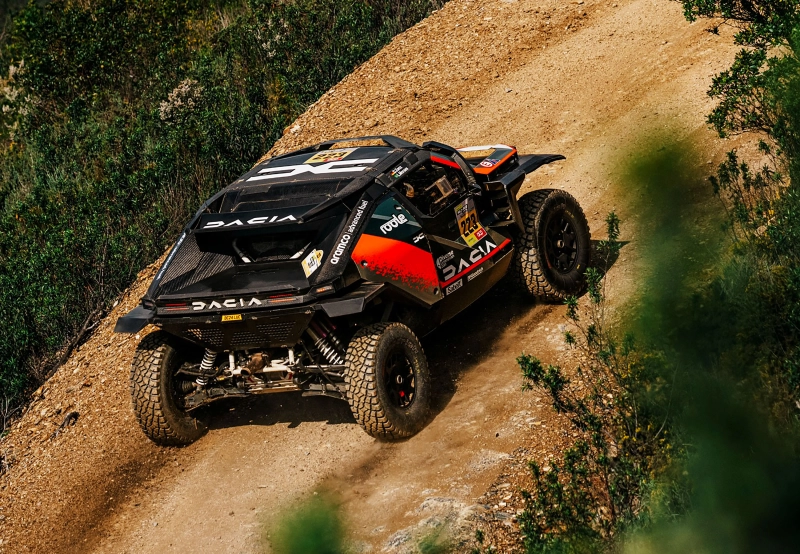
GRÂNDOLA, Portugal – In a show of strength that confirms that the Dakar success was no fluke, the Dacia Sandriders team dominated the European landscape in the second round of the World Rally-Raid Championship (W2RC). Although the dust settled over the finish line in Vilamoura today, March 22, 2026, the turning point of the entire competition remained Stage 3, a test that tested the limits of mechanical endurance and the nerves of the drivers on a ruthless cross-border route.
If the first two days were about speed and adaptation, Stage 3 represented the tough "sorting" of the podium contenders. Held on a technical course, with narrow sections and thick mud caused by recent rains, the stage took the W2RC caravan across the border, into Spain, with the start and finish in Badajoz.
For Sébastien Loeb, this stage was an exercise in mastery. Starting from the position of "pathfinder" - a thankless role in rally-raid, where the lack of tracks forces you to navigate perfectly - the Frenchman managed to limit the time loss in front of the Toyota armada.
"It was a tightrope walk. In the border forests, the Sandrider felt massive, but extremely agile on the technical sections. Opening the road here is like trying to read a map while running through a maze of brambles," joked Loeb at the end of the day.
The Dacia factory team experienced a mix of emotions worthy of a movie script during this stage. Here's how the "sand riders" fared on Lusitanian soil:
1. Sébastien Loeb – The “King” of Portugal
Loeb showed why he is considered the most versatile driver in history. Taking advantage of his vast experience in the WRC on the gravel stages of Portugal, he managed Stage 3 perfectly, consolidating his position which ultimately led him to the overall victory of the rally.
2. Lucas Moraes – The Survivor
The Brazilian from the Dacia team provided the moment of maximum tension in Stage 3. In an extremely narrow section of forest, Moraes had a hard contact with a tree. Although the body of the Sandrider prototype bore the "wounds" of the fight, the robustness of the car allowed him to continue and finish the rally in an honorable 4th place.
3. Nasser Al-Attiyah – The Champion's Misfortune
After winning the Dakar earlier this year, Nasser had a rough week in Portugal. Suspension setup issues in the early days culminated in Stage 3 with a mechanical failure that forced him to abandon the event. However, the points scored in the early stages helped Dacia remain the leader in the manufacturers' standings.
| Position | Pilot | Vehicle | Time/Gap |
| 1st | Lucas Moraes | Dacia Sandrider | 1h 03m 07s |
| 2nd | Nasser Al-Attiyah | Dacia Sandrider | +00:03 |
| 3rd | João Ferreira | Toyota Hilux | +00:10 |
Although Nasser retired later that day, the intermediate times and the forcing in the first part of the stage showed the pure speed of the Romanian prototype.
The Rally of Portugal demonstrated that the Dacia Sandriders project is not just about the sand dunes of Saudi Arabia. The car, powered by synthetic fuel supplied by Aramco, also proved to be highly competitive on the tough, varied and wet terrain of Europe.
Loeb's victory today and Moraes' solid performance confirm that Dacia has built a superior technical platform, capable of ending Toyota's years of dominance.