
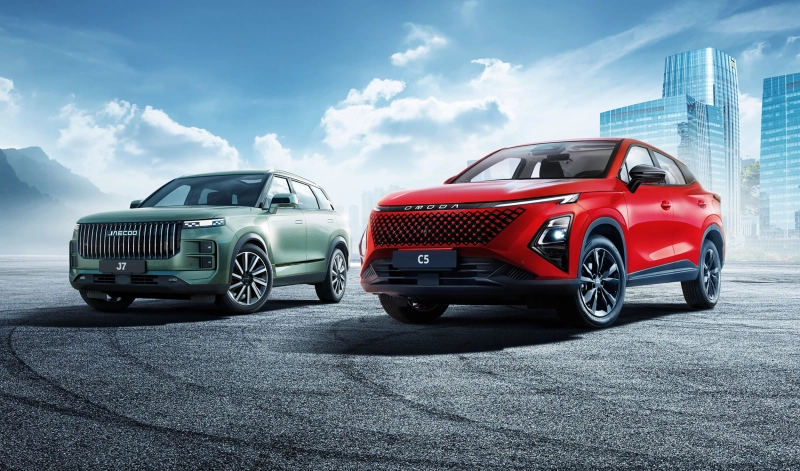
In the traditional auto industry, reaching the one million unit sales milestone was a feat that required decades of brand consolidation. Today, under the spotlight at the Beijing Auto Show, the Omoda and Jaecoo brands (under the Chery Group umbrella) demonstrated that the rules of the game have changed for good.
In just 36 months since their debut, the two divisions have managed not only to survive in an ultra-competitive market, but to become top-tier global players, with a solid presence in 64 countries.
The official announcement made in Beijing leaves no room for interpretation. March 2026 marked a historic record for the group, reflecting a strategy based on volume and cutting-edge technology:
"Our success is not just a matter of numbers, but of speed of adaptation. In three years, we have built a global community that demands innovation, not just transportation," said the brand's representatives at the event.
If the Omoda 5 was the spearhead that opened the way, the new Omoda 4, presented in a world premiere, promises to democratize technological luxury. The highlight was the Valet Parking Driver system, an intelligent technology that allows the vehicle to navigate itself in crowded parking lots, finding a free space and parking without human intervention.
This focus on "Smart Luxury" positions Omoda not just as a car manufacturer, but as a technology company on wheels.
The Romanian market has become a strategic pillar for Chery's European expansion. After the official launch, the brands managed to create a distribution network in major cities (Bucharest, Cluj, Timisoara, Iași), relying on an unbeatable recipe for the local public: futuristic design, premium features included as standard and an extended warranty.
What Romanians find in showrooms:
The speed with which Omoda and Jaecoo have gone from “project” to “millionaire in sales” is a wake-up call for traditional European manufacturers. With a clear focus on new energy vehicles (NEVs) and the integration of artificial intelligence, the two brands are no longer just “affordable alternatives” but have become first-hand options for a generation of drivers who value gadgets and sustainability as much as horsepower.
In Romania, 2026 is set to be the year in which these Asian silhouettes will go from exotic curiosities to constant presences on our roads.
Given this explosive growth of the NEV segment (almost 500% in one year), do you think the charging infrastructure in Romania will be able to keep up with the increasing number of Chinese electric cars entering the market?