
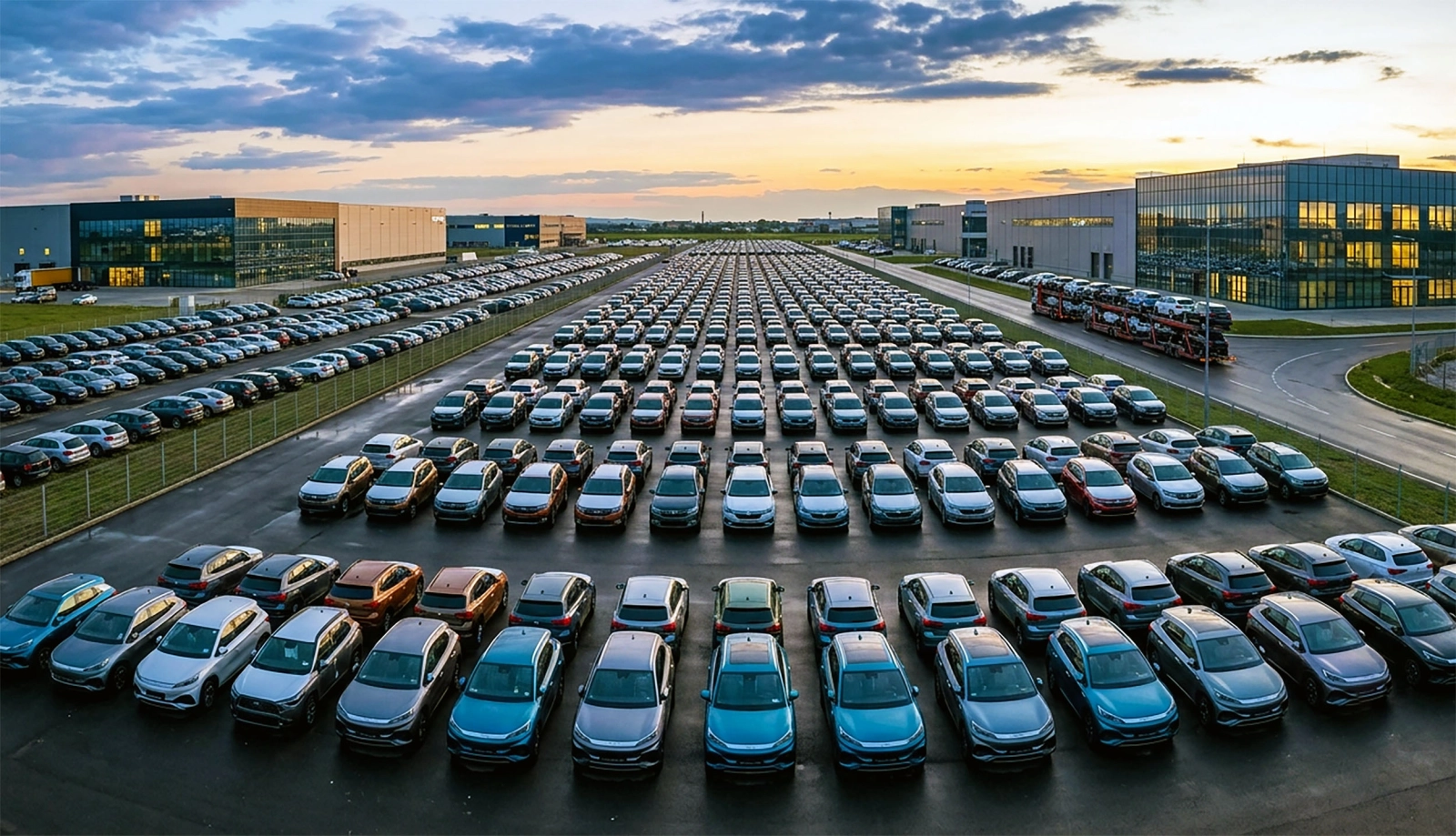
The Romanian car market offers a scenario full of contrasts in mid-2026. The latest data published by the Romanian Automobile Manufacturers Association (ACAROM) reveal a bizarre dynamic: June brought a spectacular explosion in new car registrations, but the cumulative advance over the entire first semester is on the verge of stagnation. All the while, the preferences of Romanian drivers are undergoing a radical transformation, propelling green technologies and sending diesel engines to history.
In June 2026, showrooms in Romania were busier than ever. Romanians purchased 16,120 new cars, a massive 51.9% increase compared to the same month last year.
However, the enthusiasm at the beginning of summer barely manages to compensate for the slowness of the first months of the year. For the entire semester (January - June 2026), the total sales volume reached 64,850 units. Compared to the similar period in 2025, the growth is only 0.8%, a value that places the market evolution close to the absolute minimum of recent years.
The energy transition is no longer just a future trend, but a clear reality in statistics. For the first time, hybrid cars have become the number one choice of Romanians, standing out massively in the top of preferences. In contrast, traditional gasoline and diesel engines are losing ground at an accelerated pace.
Here's how buyers' options are divided after the first 6 months of 2026:
| Engine Type | Units Sold (H1 2026) | Change vs. H1 2025 |
| Hybrids (HEV/PHEV/MHEV) | 37,563 | +17.5% |
| Petrol / Gasoline | 11,988 | -24.9% |
| LPG | 5,630 | -22.2% |
| Electric (BEV) | 5,522 | +72.5% |
| Diesel | 4,137 | -35.7% |
Trend analysis: The spectacular growth of 100% electric cars (+72.5%) shows a strong recovery in the appetite for clean mobility, while the collapse of diesel engines (-35.7%) confirms that this technology is gradually being eliminated from new car customers' options.
In the manufacturers' ranking, Dacia maintains its undisputed leading position on the local market, managing to deliver 11,686 units in the first half of the year. The domestic brand is followed at a distance by Toyota (6,761 units), which takes full advantage of Romanians' appetite for hybrid technology, and Skoda (5,474 units), which completes the podium.
The big surprise of this year's top 10 is the official entry of the Chinese giant BYD, a sign that the offensive of Asian electric cars is beginning to reconfigure the automotive landscape in Romania.
Dacia – 11,686 units
Toyota – 6,761 units
Skoda – 5,474 units
Volkswagen – 5,067 units
Renault – 3,012 units
Hyundai – 2,813 units
Ford – 2,697 units
Mercedes-Benz – 2,466 units
BMW – 2,327 units
BYD – 2,140 units
While the new car market is barely surviving thanks to its performance in June, the second-hand car sector is showing clear signs of fatigue. Romanians seem less and less interested in vehicles brought from abroad or resold on the domestic market.
In June, 27,341 second-hand cars were registered, down 15.1% compared to June 2025. The trend continues throughout the semester: between January and June 2026, the total number of second-hand registrations was 144,936 units, marking a contraction of 11.6% compared to the first six months of last year.
This constant decline in the second-hand market, correlated with the advance of new ecological vehicles, suggests a gradual maturation of the Romanian consumer, increasingly oriented towards warranty, efficiency and modern technology.