
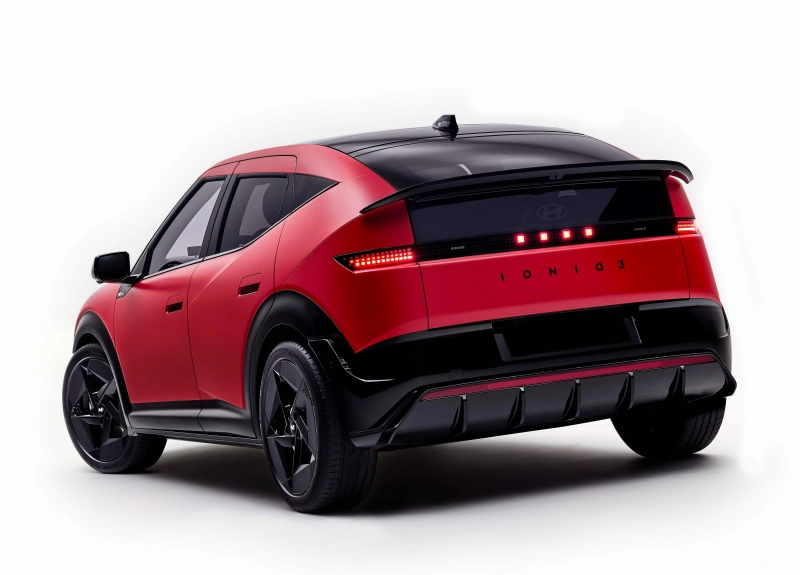
MILAN – Hyundai has chosen the prestigious setting of Milan Design Week 2026 to officially unveil the newest and most accessible member of its electric family: the new IONIQ 3. Conceived as a "game changer" for the European compact segment, the IONIQ 3 is not just an electric vehicle, but a statement of design and efficiency, propelling the South Korean brand into a new stage of sustainable mobility.
The new IONIQ 3 introduces a unique body concept, dubbed by the manufacturers “Aero Hatch”. This approach combines the flowing silhouette of a hatchback with advanced aerodynamic optimizations, resulting in a drag coefficient of just 0.263 cd, a remarkable value for this class.
Inspired by the new “Art of Steel” design language, the IONIQ 3 impresses with clean surfaces and digital details. The light signature is dominated by the famous “Pixel LEDs”, but the absolute novelty lies in the four central optical blocks that form the letter “H” in Morse code (••••) — a subtle homage to the brand name. The N Line version brings an extra layer of visual aggression, with specific body elements that extend the overall length from 4155 mm to 4170 mm.

Inside, the IONIQ 3 marks the European debut of the new Pleos Connect multimedia system. Based on the Android Automotive OS (AAOS) architecture, the system promises an ultra-fast and intuitive interface, displayed on large screens (12.9 inches as standard or 14.6 inches as an option).
The cabin takes full advantage of the dedicated E-GMP platform, offering a completely flat floor and generous space, comparable to vehicles in higher segments. Hyundai has integrated intelligent storage solutions, such as the Megabox under the boot floor, which increases the total load volume to 441 liters, making this model an ideal companion for urban families.
Hyundai offers two technical configurations adapted to different driving needs:
Thanks to the 400-volt architecture, both versions benefit from fast charging: a 10% to 80% charge takes approximately 29-30 minutes. In addition, V2L (Vehicle-to-Load) technology allows users to power external devices directly from the car's battery.
A major strategic move is Hyundai’s decision to build the IONIQ 3 at its plant in Izmit, Turkey. This location will become a central hub for exporting the model to major European markets such as Germany, France and the UK. Localizing production will not only reduce the logistics carbon footprint, but will also allow for a competitive price against new rivals such as the Kia EV3 or Volvo EX30.
The new Hyundai IONIQ 3 comes equipped with the full SmartSense safety suite, including leading technologies such as Highway Driving Assist 2 and Digital Key 2, reinforcing the model's position as a technological leader in the compact electric segment of 2027.
For the Romanian public, the Hyundai Ioniq 3 represents one of the most anticipated launches of 2027, promising to become a formidable competitor for models such as the Dacia Spring (in its higher versions) or the future Renault 5 Electric. According to sources within the Hyundai Romania distribution network, the first units are expected to arrive in local showrooms in the first quarter of 2027.
In terms of financial aspects, Hyundai positions the Ioniq 3 as a volume model, aimed at democratizing access to the IONIQ range. Although official prices for the local market have not yet been finalized, current estimates place the starting price for the Standard version (42.2 kWh) at approximately 24,500 - 26,000 euros (without subsidies).
The Long Range version (61 kWh), which will probably be the favorite of Romanian customers due to its autonomy of almost 500 km, could have a starting price of around 31,000 euros.
"Ioniq 3 is the missing piece of our puzzle for Romania. With a competitive price and 400V technology, it will attract customers who want an electric family car, capable of intercity roads, not just urban commuting," say local auto market analysts.
A decisive factor for the success of the new model will, of course, be the Rabla Plus program. If government subsidies remain attractive in 2027, Romanian customers could purchase the new Ioniq 3 at a final price that could drop below the psychological threshold of 20,000 euros, instantly transforming it into one of the best-selling electric vehicles in the country.
Interested customers will be able to opt for online reservations starting in the fall of 2026, with Hyundai also preparing special launch packages that include home charging stations and an extended 8-year warranty for the traction battery.
The launch of the new Hyundai Ioniq 3 marks a moment of maturity for the South Korean automaker's electric range. With this model, Hyundai not only expands its portfolio, but also demonstrates that aerodynamic efficiency and cutting-edge technology do not have to remain the prerogative of luxury segments.
The Ioniq 3 ticks all the boxes for the modern driver: an eye-catching Aero Hatch design, a range that takes the stress out of long journeys, and an operating system, Pleos Connect, that brings digitalization to an intuitive level. Furthermore, the decision to produce this model in Turkey underlines the brand's commitment to the European market, ensuring faster availability and optimized logistics costs.
In conclusion, the Ioniq 3 is not just “another electric car” in an increasingly crowded market. It is a fulfilled promise to offer a sustainable, practical and, above all, affordable alternative. If the price estimates are confirmed, the new member of the Ioniq family has every chance of becoming, starting with 2027, the familiar image of electromobility on the streets of Romania and throughout Europe.