
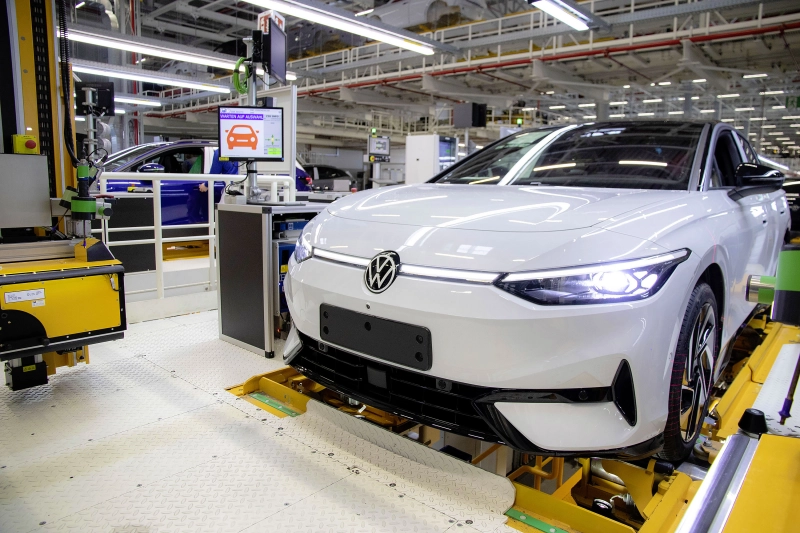
Germany confirmed its status as the "locomotive" of the European automotive industry in 2025, reaching historic milestones in the production of electric vehicles. While factories in Wolfsburg, Munich and Stuttgart worked at full capacity, the Romanian market reflected a nuanced interest, oscillating between the pragmatism of new cars and loyalty to German brands on the second-hand market.
According to the latest data from the German Automobile Manufacturers Association (VDA), 2025 marked an all-time record: 1.22 million electric cars were produced. This represents a 15% increase over the previous year, consolidating Germany's position as the world's second largest producer, after giant China.
World Production Ranking in 2025:
| Rank | Country | Production (Million Units) |
| 1 | China | 16.1 |
| 2 | Germany | 1.22 |
| 3 | United States | 1.04 |
To support this pace, the German government has launched a massive €3 billion subsidy program, valid until 2029, offering between €1,500 and €6,000 per vehicle for low- and middle-income families.
In Romania, the automotive landscape last year was dominated by a surge in interest in hybrids, while the electric segment stagnated slightly. However, German brands (or those under the umbrella of German groups) remain Romanians' favorites in the top of new car sales.
Out of a total of approximately 157,000 new cars registered in Romania in 2025, the share of German brands is impressive:
Skoda (VW Group): 11,299 units (4th place overall);
Volkswagen: 9,783 units (5th place);
Mercedes-Benz: 5,488 units (Leader in the premium segment);
BMW: 5,430 units (Historical record for the Bavarian brand in Romania).
Although Dacia remains the undisputed leader (over 45,000 units), cumulatively, German brands represent the core of the preferences of those who choose imported cars.
If you want a piece of German engineering produced in 2025, your budget has to adapt to the chosen segment. Here are the prices in showrooms in Romania:
1. Affordable / Compact Segment
Here we find models like the Volkswagen ID.3 or the Skoda Enyaq. Prices start at around €32,000 – €35,000. Although they are considered “entry-level”, the technological features remain at high standards.
2. Mid-Range / SUV segment
The most popular choices, such as the VW ID.4, BMW i4 or Audi Q4 e-tron, ranged around €45,000 – €65,000. This is the segment where Romanians seek the balance between autonomy (over 500 km) and prestige.
3. Premium / Luxury segment
Top-of-the-range models such as the BMW iX, Mercedes EQS or Porsche Taycan have frequently exceeded the €90,000 – €120,000 threshold. In 2025, BMW reported that 1 in 4 cars sold in Romania was electrified, a sign that the premium audience is making the transition the fastest.
Even though German production has set records, the Romanian market remains one of contrasts. While Western Europe accelerates towards electric, the average Romanian still looks with nostalgia (and ready wallet) to the second-hand market, where 4 out of 10 cars imported in 2025 were also of German origin. However, new subsidies and a booming charging infrastructure promise an even more electrifying 2026.