
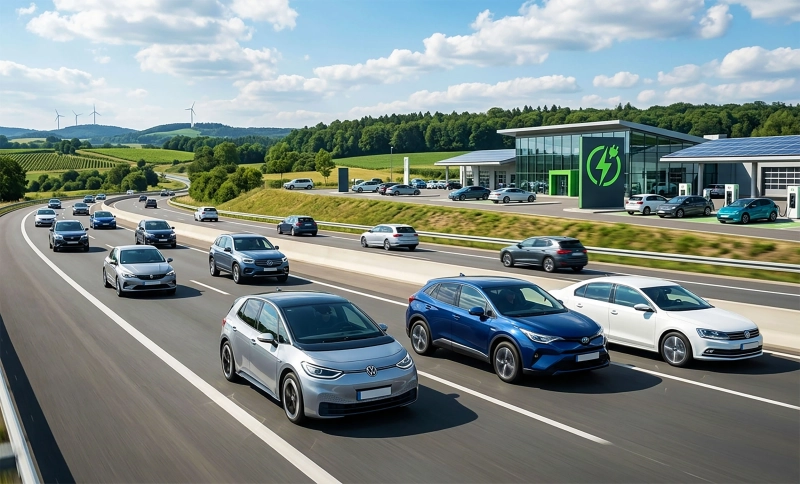
In a geopolitical context dominated by uncertainty and record prices at the pump, the European car market offered a show of resilience and radical paradigm shift in March. According to the latest data provided by the European Automobile Manufacturers' Association (ACEA), Europeans not only bought more cars, but also decisively accelerated the transition to electric propulsion.
In March, Europeans registered a total of 1,581,169 new cars, marking a solid increase of 11.1% compared to the same period in 2025. This figure, which includes data from the European Union, EFTA countries and the United Kingdom, comes against a backdrop of an acute need for efficient mobility.
The big surprise – although predictable in the current climate – comes from the battery electric vehicle (BEV) segment. Their sales exploded by 41.7%, reaching a volume of 344,064 units.
Critical Context: This explosive growth is no coincidence. Experts point to the oil crisis triggered by the Iran conflict as the main "marketing agent" for zero-emission cars this spring.
Although electric cars are stealing the spotlight, hybrid cars (HEVs) remain the preferred option of European pragmatism, dominating the sales rankings.
| Propulsion Type | Units (March 2026) | Evolution vs. 2025 |
| Hybrid (HEV) | 607,826 | +15.3% |
| Gasoline | 352,700 | -10.2% |
| Electric (BEV) | 344,064 | +41.7% |
| Plug-in Hybrid (PHEV) | 158,377 | +31.9% |
| Diesel | 91,023 | -14% |
There is an accelerated collapse of diesel engines, which have come to represent an increasingly narrow niche, while gasoline has lost over 10% of its market share in a single year.
Looking at the first three months of 2026 as a whole, the European market absorbed 3,521,110 new cars (+4.1%). The absolute star of the quarter is PHEV (plug-in hybrid) technology, with a growth of 32.4%, a sign that many consumers are still using these vehicles as a "bridge" to full electrification.
At the opposite end, gasoline engines saw a 17% decline in the first three months, confirming that the era of pure fossil fuels is coming to an end in Europeans' preferences.
The hierarchy of auto giants remains stable, but with interesting nuances at the volume level:
The Mioveni brand had a mixed performance. In March, Dacia sold 57,904 units (+2%), but the balance for the first three months shows a decrease of 17.7% (126,157 units). This evolution suggests a readjustment of stocks or a change of strategy in anticipation of the brand's new electrified models, in a market that no longer forgives the absence of "green" options.
March 2026 will go down in history as the moment when panic at the gas stations was converted into electricity bills. Europe is not only moving, but it is doing so more and more silently and independently of classic resources.
What do you think will be the threshold at which electric cars will definitively surpass gasoline car sales in Europe?