
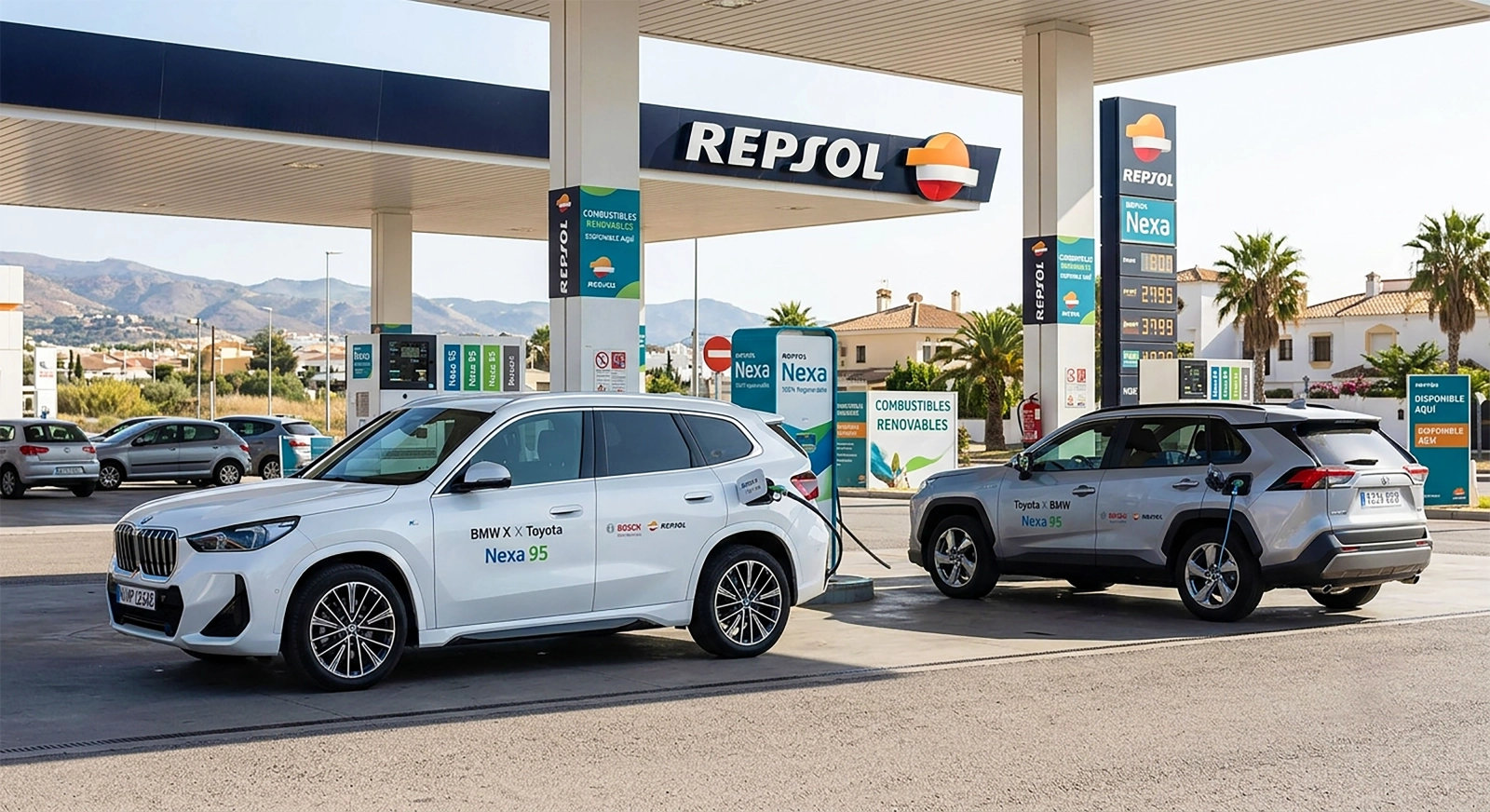
At a time when debates about the future of mobility in Europe are more intense than ever, automotive giants BMW and Toyota are joining forces once again to demonstrate that decarbonizing transport does not depend solely on a rapid transition to battery electric vehicles. The two companies have launched an innovative pilot project in Spain, designed to test the efficiency and viability of renewable fuels in real-world driving conditions.
The project will run for six months and will involve a fleet of around 20 vehicles. The main goal is clear: to demonstrate the ability of these technologies to significantly reduce the continent's carbon footprint, offering a complementary and immediately applicable solution for the existing car fleet.
The success of such an endeavor directly depends on the fuel used and rigorous performance monitoring. For this reason, BMW and Toyota are working closely with industry-leading partners: technology giant Bosch and energy company Repsol.
Spain was chosen as the scenario for this test precisely because of the infrastructure developed by Repsol, the only distributor in the country that makes 100% renewable fuel available at public filling stations. The vehicles involved in the project will be fueled exclusively with Nexa 95, the fully renewable formula developed by Repsol.
To accurately measure the impact and technical parameters, the project uses the Digital Fuel Twin system, developed by Bosch. This digital monitoring and tracking technology will centralize and validate all consumption and emissions data generated during the six months of testing.
The initiative of the two manufacturers is structured around three strategic pillars essential for the future of the European automotive market:
What makes this pilot project truly unique is its technological realism. The tests are not carried out on laboratory prototypes or expensively modified vehicles, but on existing production models from the BMW, Toyota and Lexus brands.
By using cars that customers can already buy in showrooms, the partners want to demonstrate that new synthetic fuels can replace conventional petrol without requiring fundamental changes to the engine or exhaust systems. If the test achieves its objectives, it could open up a new path to extending the lifespan of internal combustion engines while delivering a drastic reduction in CO2 emissions on Europe's path to climate neutrality.